Wednesday, August 19, 2020

Mourning Doves

Mourning dove (internet download)
Recently, our backyard revealed a ‘puddle’ of feathers about a yard across. Best guess is that a hawk had caught and killed a mourning dove, and then proceeded to pluck feathers before flying away with the carcass.

Mourning doves – older names turtle dove and Carolina turtledove – are a common bird across America, with a population estimated at 300 to 400 million birds. Doves are a light grey and brown in color, with only subtle differences in appearance for males and females. Mated pairs are monogamous. Two eggs are laid per nesting cycle. A pair will raise several broods each year. Both parents participate in nest building, egg incubation and feeding the chicks (also referred to as squab). Although doves feed on seeds and grains, very young chicks are not fed seeds, but rather a protein- and fat-rich secretion from the parent birds’ crop, called “crop milk.” [The crop is a pouch just below the throat. Many species of birds can fill this with food to digest later or else regurgitate into their chicks’ mouths.]  As chicks get larger, seeds the parents have swallowed into their crop are combined with crop milk. With such a rich diet, chick fledge – are able to fly – within two weeks from hatching. The parents will continue to feed them for an additional week or two, but will have also laid eggs for the next brood.

In captivity, lifespan can approach 20 years. This, plus all the fecundity would cover the countryside knee-deep in mourning doves, except that predators find them easy to catch. In the wild, average lifespan is less than two years. Ravens and crows take chicks from nests, fledged chicks are easily caught by many predators, and adults end up in the food chain because they are ground feeders. Prior to European colonization, the major predators of adult dove were hawks and falcons, attacking from above. Add to that cats (pet and feral), and the life of a dove can be brutally short.  

Feathered evidence of a hawk kill
The predator that left us the feathered evidence was most likely a Cooper’s hawk. This is a relatively small but very agile hawk that preys primarily on birds. Red-tailed hawks are larger, but a bit too slow to be bird predators, preferring instead rabbits and squirrels. The other possible culprits would have been peregrine falcon, or sharp-shinned hawk, but these are relatively rare in eastern Massachusetts. In addition to doves, Cooper’s hawks will also prey on robins, starlings and sparrows – also ground feeders. Attacked birds are taken either on the ground or while trying to take off. One estimate has each hawk killing on average two birds a day.

In describing mourning doves, John J. Audubon wrote “Whenever it starts from a tree or the ground, on being unexpectedly approached, its wings produce a whistling noise, heard at a considerable distance.” This is an example of “sonation,” defined as sounds produced by birds, using mechanisms other than the vocal organ. Humans make sounds by means other than voice: we snap our fingers, clap our hands, slap our thighs, stomp our feet and click our heels. For some bird species the sound making is voluntary, typically related to males claiming territory or their mating display. The male palm cockatoo of New Guinea uses a claw-held stick to drum on a hollow tree he has selected as a possible nest site. The female, attracted by the noise, checks out the real estate.

For mourning doves, the taking off sound is involuntary but mallable. Birds often form flocks to increase collective vigilance, thus allowing early detection of predators. This benefit of sociality relies on rapid transfer of information. For many species, an alarm call, but for pigeons and doves, one of the flight feathers on each wing is modified so that on take-off, with the wings fully extended for extra lift, the modified feather rapidly flutters against the next feather during the wings’ downstroke, making an easily heard noise. This noise is present whenever mourning doves take off, but if the cause is alarm from detecting a predator, wings beat faster and the pitch is higher. Taped recordings of regular and alarmed take-offs confirm that other doves respond more to the sound of alarmed take-offs.

Is this altruism or self-interest? Assuming this evolved under predation by hawks, one bird taking off from a group on the ground may just be making itself the best target. But if all the birds take off, the visual complexity of the group may cause the attacking hawk to lose sight of an individual bird, and perhaps even miss all of them. Once in the air, mourning doves can reach speeds in excess of 50 miles per hour. Bye Bye Birdie.   

For mourning doves, much like robins, migration is optional. Given enough food, males of both species will remain behind, forming loose flocks of 10-30 birds. Their reason for not leaving is to have dibs on the best territory when the females return in the spring. Robins will find and plunder berries such as winterberry and Asian bittersweet. Mourning doves will seek out remnant grains in farm fields and cluster under birdfeeders to benefit from what perching birds have spilled to the ground.

Lastly, from James Lipton’s “An Exaltation of Larks”: a group of doves is called a "dule," (pronounced ‘dool’) taken from the French word deuil (mourning), because “The soft, sad ululation of the dove has always evoked the sense of mourning.”

Wednesday, August 12, 2020

Science Is Real

Science is real. Science is also slow, and sometimes science takes detours. A May 2018 column was about the rise and fall of vitamin E. Briefly, back in the 1990s, claimed benefits led with reducing risk of cardiovascular disease and some types of cancer, but piled on with claims for results for macular degeneration, pregnancy, dementia and other diseases. With no apparent concerns about safety, there was a race up to mega-dose amounts being widely sold as non-prescription dietary supplements. Then the bad news – results from large, placebo-controlled human trials – started to trickle in. As Thomas Huxley put it, “The great tragedy of science – the slaying of a beautiful hypothesis by an ugly fact.”

Yes, vitamin E was confirmed as an antioxidant, and the oxidation theory of diseases of aging is one of cumulative damage. Healthcare professionals who chose to consume a vitamin E dietary supplement had a 1/3 reduction for risk of cardiovascular disease. Sadly, subsequent years-long clinical trials concluded that there was at best a modest reduced risk of heart attack at low doses, increased risk at high doses, no benefit for risk of stroke, and no improvement in all-cause mortality. With hindsight, in the initial research, health professionals who had decided to consume vitamin E supplements may have made other lifestyle decisions that promoted good health. It is an example of correlation not necessarily reflecting causality. Research for other diseases also had mixed results: nothing for pregnancy, nor hair, nor for topical applications for burns or wound healing; mixed results for cancer. There was a trickle of evidence that amounts over 200 mg/day had negative consequences. Sales of dietary supplement vitamin E declined dramatically.

Niacin is both a vitamin and a prescription medication. As a vitamin, intake recommendations made by several countries are that for adults, intakes of 14–18 mg/day are sufficient to meet the needs of healthy people. When niacin is used as a medicine to treat elevated triglycerides and serum low-density lipoprotein cholesterol (LDL-C), daily doses range from 500 to 3,000 mg/day. The LDL-C lowering effect was discovered by accident; niacin was being investigated as a treatment for hypertension, and then in 1952 a group of Russian scientists reported cholesterol-lowering as a side effect. Prescription niacin became widely used as a hyperlipidemia treatment drug some 30 years before the approval of the first statin drug in 1987.

All that is well and good and still true, although the advent of statins, which were more effective that niacin and with fewer side effects, reduced niacin prescriptions by 90 percent. Where niacin veered into a science detour was a second purported health benefit. In addition to lowering LDL-C, niacin also raises high-density lipoprotein cholesterol (HDL-C), often referred to as “good” cholesterol. Population studies showed that people with higher HDL-C were at lower risk for cardiovascular disease. Lifestyle interventions that raised HDL-C, such as exercise or moderate consumption of alcohol, also correlated with lower risk. Collectively, this suggested that HDL-C was a valid biomarker. However (the beautiful hypothesis slain by the ugly fact), niacin in combination with a statin drug proved no better for clinical outcomes than the statin alone, despite having raised HDL-C. Prescription products that had combined niacin with a statin (Simcor, Advicor) were discontinued in 2016.

And now, almost every known drug is being tested for COVID-19 benefits, including known antivirals and repurposed other drugs (and not just drugs – vitamins D and C are being evaluated, too). Hydroxychloroquine – an anti-malarial with other approved treatment indications – has its champions in the COVID-19 arena (“It works on my patients.”), but to date, placebo-controlled clinical trials have shown no evidence that it prevents people from contracting the disease if exposed, no evidence for a faster recovery among those afflicted, and no significant reduction in the percentage of COVID-caused deaths. There are serious adverse reactions (heart, liver, kidney), known to be associated with this drug. There are more trials ongoing, some of which may indicate a benefit, but until there is a clear consensus, doctors are advised to not prescribe this drug for this indication, but because it is approved for other indications, doctors have the option of going “off-label” and prescribing it for COVID, regardless. Again, science is real, science is also slow, and sometimes science takes detours.

Wednesday, August 5, 2020

Ruby-throated Hummingbirds

"Why is this bird different from all other birds?" Hummingbirds represent an evolutionary expansion into a niche frequented by flower-pollenating moths and butterflies. Downsizing and an elongated beak and tongue combination allows these birds to feed on flower nectar. The adaptation initially took place in tropical climates where the ability to retain body heat – typically a function of larger body size – was not critical.

More than 300 hummingbird species inhabit the Central American tropics. Only 16 frequent the U.S., and of these only one species - the ruby-throated hummingbird - migrates east of the Mississippi River. The rest go west. The risks of a longer eastward migration are offset by having a monopoly on the hummingbird niche once they arrive.

Painting of a male Ruby-throated Hummingbird
Ruby-throated hummingbirds winter in Mexico, then migrate as far north as Canada in the spring. Their journey begins with gorging on insects until body weight is almost doubled, then launching into a night-long flight from the Yucatan peninsula of Mexico to the U.S. Gulf Coast. The fuel for this comes from gorging on small insects and flower nectar. Once over land again, they revert to daylight eating every 10-15 minutes, consuming more than half their body weight over the course of each day.

In eastern Massachusetts these birds are in residence from May through September. The slightly larger, less brightly colored females arrive a week or two after the males. Males do not help with nest construction, egg incubation or feeding. Hummingbirds do not flock. A yard with multiple feeders can be host to several birds at the same time – a “charm” of hummingbirds – but in reality, what is seen is a temporary truce around a shared resource. Each bird, sated, goes back to its own territory.

Females lay two eggs. Nests are the size of a ping-pong ball, eggs the size of a coffee bean. Gestation is two weeks. Chicks are ready to leave the nest three weeks after hatching. Fledgling survival to adulthood is high compared to other species, and lifespan about five years if the fledglings survive the first migration. By comparison, a nesting pair of golden-crowned kinglets (a small, Maine-dwelling bird twice the weight of a hummingbird) will hatch two broods over the course of a summer, each numbering 8-10 fledglings, yet only one or two survive to the following year’s breeding season.

Hummingbirds are omnivores - they get carbohydrate calories from flowers - but all of their protein, fat, vitamins and minerals from eating gnat-sized insects. Sugar-water feeders supplement the energy needs also met by flower nectar. A well-managed feeder should attract visitors from May to September. For a natural alternative, plant monarda, honeysuckle, trumpet vine, and other hummingbird-friendly perennials. Do not use pesticides, as these will kill the small bugs hummingbirds also need to consume. Feeders do not deter hummingbirds from the urge to migrate south in the fall. 

Ruby-throated hummingbirds have some interesting dependencies on other species. Males arrive in the northeast before most of the flowers have opened. Instead of relying on nectar, the birds also feed on tree sap from holes drilled in trees by yellow-bellied sapsuckers. Females construct nests incorporating spiderweb silk.

Part of mural on the building at the corner of  Parker 
& Waltham Streets = male, broad-billed hummingbird.
In addition to small size and hover capacity hummingbirds employ an unusual energy conservation strategy - extreme body temperature modulation. During cool summer nights these birds allow their body temperature to drop from 105 to about 70 degrees Fahrenheit. Resting heart rate drops from 500 to 50 beats per minute (rate while flying can exceed 1,000). Without this trick of lowering energy expenditure via torpor they risk overnight starvation. Muscles are rewarmed in the morning by shivering.

Maynard is blessed with a hummingbird mural on the south side of the building at the corner of Waltham and Parker Streets. The bird in question is a male, broad-billed hummingbird, a species that winters in central Mexico but migrates as far north as southern Arizona during breeding season.   

A version of this column was published in 2012

Wednesday, July 22, 2020

Alcohol: What is Moderation?

“Correlation does not imply causation.” Simply put, for two variables if both change, one cannot simply conclude that there is a cause-and-effect relationship between the two. Back in the late 1980s, alcohol, and more specifically, red wine, got a health claims boost from the “French Paradox,” an observation that the French, while known for consuming a butter- and cheese-containing diet high in saturated fats, had a lower than expected incidence of heart disease. This branched into two sets of putative health claims: A) That moderate consumption of alcohol was healthier than not drinking any; and B) that chemicals in red wine had a health benefit separate from the alcohol content.
For alcohol beverages, "Proof" is
2X percent. 'Hard liquor' products
tend to be 80 to 100 proof, labeled as
such, whereas wine and beer are labeled
percent alcohol content.

The observation about alcohol in any form, i.e., wine, beer, spirits, got support from what is described as a “J-shaped curve”, meaning that the relationship between alcohol and cardiovascular or all-cause mortality was not a straight line – with more drinking linked to more deaths – but rather a curved line the lowest risk at a modest alcohol intake, higher risk at zero alcohol intake, and ever-increasingly higher risk at higher and higher intakes (visually, the line resembles an aslant letter “J”). The “sweet spot” (lowest risk) looked to be around one-half to one drink per day.

Red wine contains proanthocyanidins, large molecules that contribute to the astringency of wine. Red wine also contains resveratrol, a small molecule upon which huge health claims were heaped. All sorts of health claims were made for resveratrol dietary supplements, even though the ingredient in question was being extracted from Japanese knotweed rather than grapes. Whilst positive results were demonstrated in animal models, in the end, human trials showed no benefits for lifespan, anti-cancer, anti-dementia, and so on. There was a lot of hullabaloo about resveratrol-like compounds as drugs, but that petered out. The proanthocyanidin story was latched onto by proponents of other natural sources of these compounds, leading to some positive-finding research and a lot of market hype for dark chocolate, blueberries, purple grape juice, and so on. Research on this is still a work-in-progress. Newest thinking is that while proanthocyanidins have antioxidant activity, this is not the mechanism of action.

Back to alcohol. Clearly, there are non-benign consequences of excessive drinking, defined both as a high average per week and occasions of binge drinking, the latter defined as five or more drinks for men and for or more for women. The Centers for Disease Control and Prevention (CDC) estimates that alcohol consumption accounts for approximately 100,000 deaths annually in the United States. That includes motor vehicle fatalities, drownings, suicides and homicides, liver cirrhosis and at least seven types of cancer. Excessive drinking also contributes to non-fatal negative consequences (injuries, arrests, home violence…). As to the alcohol “J-shaped curve,” it turns out that in many cultures, when compared to not drinking at all, modest amounts of alcohol consumption tends to be associated with many risk-lowering behaviors, such as less absence of obesity, more exercise, better diet and being non-users of tobacco. Non-drinkers can also have mental and physical illnesses that led them to never starting to drink in the first place, or else are non-drinkers now because of past illness. Either way, their non-drinking could contribute to the higher incidence of disease and death of non-drinkers that had nothing to do with any purported benefits of modest drinking.   

All this leads up to the fact that the Dietary Guidelines for Americans, a document that is updated every five years, is about to revise downward the definition of moderate consumption of alcohol. Below, a summary of the proposed guidelines for consumption of alcohol-containing beverages. It remains to be seen whether lobbying by the alcoholic beverages industry will lead to a restoration of the current definition of moderation – for men – as up to two drinks per day, of if this downward revision will stick. Draft wording: A) Do not begin to drink alcohol or purposefully continue to drink because you think it will make you healthier; b) If you drink alcohol, at all levels of consumption, drinking less is generally better for health than drinking more; and C) For those who drink alcohol, recommended limits are up to one drink per day for both women and men.

Different countries, different definitions of ‘moderation.’ Back in the 1950s, France recommended that people limit themselves to no more than one bottle per day. Currently no more than two drinks a day for both men and women, recently changed from three and two.

Wednesday, July 15, 2020

An Absence of Yard Sales

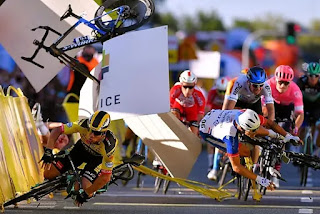
A bicycle race peleton in 'yard sale' mode
A bicycle race peloton in 'yard sale' mode

COVID-19 has changed our lives in many ways, including a dearth of yard sales. The evidence is an absence of signage stapled to telephone poles. Even if held outside, the thought of people gathering, people touching stuff, people touching money, and then the sellers having to handle everything that did not sell, is a strong disinclination. Maybe next year.

In the U.S., the origins of yard sales and garage sales date to the 1950s and 1960s, when American movement from cities to newly built suburbs meant that people had yards and garages, while their prosperity meant that they had a surplus of material possessions. Rather than just discard all that stuff, a Saturday morning with laden tables in the driveway and larger items displayed on the grass cleared clutter from the house and made pocket money for the family.  However, the term ‘yard sale’ has a much, much older history.

Back in the 16th century, “romage” (French) meant to arrange cargo in a ship so that it was stowed closely and securely. Romage came to apply to ships’ goods that were damaged in voyage and thus no longer wanted by the owners, or just unclaimed at the end of the voyage, unloaded, and sold at a shipyard sale. Romage in time took on a near-opposite definition of searching a ship’s cargo carefully and thoroughly, as in a search for smuggled goods. Romage also became “rummage”: “To hastily search for something in a confined space and among many items by carelessly turning things over or pushing things aside.” As in rummaging in a purse to find a ringing cell phone. By the late 1800s, a church or charitable organization would accept donated goods to pile on tables, so that buyer could rummage through to find what they wanted. And voila! – we have both (ship)yard sale and rummage sale.

Traditionally, here in Massachusetts, yard sale season was Memorial Day to Labor Day, but there has been some stretch at both ends. And while typically a solo venture, there have been innovations. Garage Sale Day, created in 2001, occurs on the second Saturday in August. “The World’s Longest Yard Sale” takes place every August along 630 miles of Highway 127, spanning five states. A yard sale as plot device has anchored several movies: “The Yardsale, Yard Sale” and “Everything Must Go.” And who can forget the scene in “Waiting to Exhale” when Bernadine (Angela Bassett) has just learned that her husband of 11 years is leaving her for another woman, and she first burns all his clothes, and then sells all of his worldly possessions for one dollar each at a vindictive yard sale.

Snow skier in mid-tumble. Internet down-
load. Click on image to enlarge.
‘Yard sale’ has an entirely different, although distantly visually related, definition for skiers and bicyclists. For both sports, gravity is your friend until it is your enemy. For skiers, a classic yard sale leaves you and your equipment scattered across the snow – you here, poles there, hat gone astray, and always the possibility that one of your skis will decide continue the descent without you.

Bicyclists have the option of a solo or group yard sale. Alone, you are swooping down a steep road into a banked right-hand turn at a PAY ATTENTION forty mile per hour. Under the shade of an oak tree, not seen until too late, is a scattering of acorns, some whole, some car-flattened. Given that your tire is only one inch wide, not much is needed to turn your line of descent into jittery panic. With luck (skill?) you lay the bike down to the right and accept a shredding of bike shorts and significant road rash, knee to hip. Alternatively, you and the bike part company, you in a bloody heap, the bike in pieces scattered roadside. Yard sale!

“Peloton” is a French word for a pack of riders in a bicycle race. Riders take turns at the front of the pack, where the air resistance is highest, allowing their teammates a rest. In famous, multi-day races such as the Tour de France, teams of nine riders compete. The team leaders are coddled along in the peloton until it is time to break out to the front. Zipping along at 25 miles per hour, scant inches from surrounding riders takes skill, and even with skill, there are multi-bike crack-ups, leaving riders and bikes scattered roadside. Yard sale!!

“Free” is often the weekends’ finale to yard sales: Saturday for selling, Sunday for adding a “FREE” sign to what is left, Monday for seeing if what’s left will fit in the trash can. “Freeboxing” refers to a community-established location – say, for example, boxes on a table at a senior center – where people can leave things for others to take. For the electronically inclined, Craigslist Free is another way find takers of what you no longer need. Or you can pay the “GOT JUNK” people to haul it away.