Calder, Warhol and Dali are among the most frequently forged
20th century artists.
Alexander Calder (1898-1976) is best known for his mobiles
and stabiles, the former made of metal shapes and wire, moving in response to
air currents, the later to pieces that stand on the ground – some quite
monumental in size – without movement. Auction prices for these one-of-a-kind
pieces range from $1,000,000 to $15,000,000. As Calder's professional
reputation expanded in the late 1940s and 1950s, so did his production of
paintings and of lithographs (prints), the latter typically produced as a
limited edition, each copy signed and numbered by Calder. Current prices for signed
lithographs range from $1,000 to $10,000.
In 1987, the Calder Foundation (https://calder.org/)
was established by Calder's family, "dedicated to collecting, exhibiting,
preserving, and interpreting the art and archives of Alexander Calder.” The
Foundation identifies misattributed works, either complete forgeries or
unauthorized lithographs of his art (see https://calder.org/contact/misattributed-works/).
Forgeries, often two-dimensional lithograph abstracts in the Calder-associated red, blue,
yellow and black, are an ongoing problem. Owners of work thought to be by
Calder can be submitted to the Foundation for examination and registration in
the Foundation’s archive.
A catalogue raisonné (critical catalogue) is a
comprehensive, annotated listing of all the known artworks by an artist either
in a particular medium or all media. The works are described in such a way that
they may be reliably identified by third parties. There have been several
serious authenticity issues concerning Calder’s work. In 1993, the owners of Rio
Nero (1959?), a sheet-metal and steel-wire mobile ostensibly by Calder, went
to the United States District Court for the District of Columbia charging that
it was not by Alexander Calder, as claimed by its seller. Klaus Perls, a
recognized Calder expert and manager of sales of Calder’s output from 1954 to 1976,
had declared it a copy. There were also issues of work supposedly designed by
Calder but not created until after his death. For example, stage sets designed
by Calder but built after his death were rejected by the Calder Foundation. The
Foundation was known at times to err – in 1999 it had declared a hanging glass
dove to be fake and had it destroyed; it was later confirmed as a genuine work
from 1955.
Ironically, after Perls death in 2008, the Calder Foundation
sued his estate for $20,000,000, accusing it for holding and selling hundreds
of Calder works that were not known to the Foundation, then channeling the
proceeds into his Swiss bank account, and also knowingly or unknowingly selling
counterfeits. The lawsuit was dismissed in 2013, with Judge Kornreich of the
New York Supreme Court describing it as “An incoherent stew of irrelevance and
innuendo.”
In 1995, questions arose about another purported Calder, Two
White Dots. Calder had created a model for a stabile in 1973 and sent it to
the Segré Foundry in Connecticut, a business that had for decades created the
full-size stabiles and mobiles so submitted. In this instance, the Foundry
constructed a full-size version in 1982 and sold it in 1983 for $70,000.
Subsequent sales, all claiming it was a Calder artwork, ended with a purchase
for $1,000,000 in 1995. It was subsequently submitted to and rejected by the
Foundation. The gallery that had sold the work refunded the million dollars and
sued the Foundry. The suit was settled out of court.
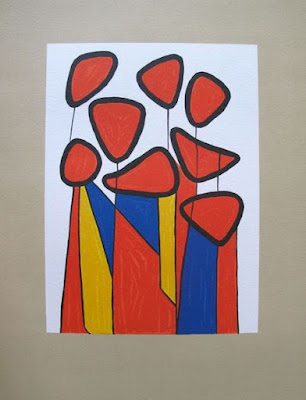 |
Alexander Calder "Squash Blossoms"
unsigned, not numbered, circa 1972 |
Back to lithographs, and specifically to
Squash Blossoms,
a lithograph print I purchased for $125 in 1974, shortly after starting my
first post-college job as a lab technician at Harvard Medical School. Mine is
signed and marked
a/p, signifying
artist’s proof, a term applied to test copies run for the artist’s approval
before a numbered run is printed. This artwork was created by Calder in 1972
for a book titled
XXe Siecle - a Homage to Calder, published in Paris by
San Lazzaro. Each copy of the book came with an original lithograph in color,
unsigned and unnumbered. No information on how many books printed. There was also a numbered run. The
lithograph was done by Mourlot Printer, Paris, France.
And here is where the question of forgery arises. A
Google images search on Calder "Squash Blossoms" yields many examples of the lithograph
either for sale now or previously sold by galleries or at auctions. One
identifies that particular lithograph as being number 6 out of production run
of 100. Other are unsigned (likely separated from the book), or signed and
indicated on the left lower corner as a/p, E.A, or H.C. As noted, a/p signifies
artist’s proof; E.A for épreuve d'artiste, meaning the same in French. Unnumbered
prints that are gifted to someone the artist knows personally or are for some
reason unsuitable for sale are marked "H. C.", meaning "hors de
commerce", i.e., not for sale. My guess is that some (all?) of the E.A.
and H.C. prints were separated from the books and have forged signatures.
(There are copies of the book for sale which indicate the lithograph was
removed.) It is also possible that fake prints were made at a later date. Sales
prices appear to be under $500 for unsigned and $500 to $2,000 for signed


