Saturday, July 26, 2025

Thoughts on getting older

 Appreciation for the many websites with funny quotes about aging

Every part of your body has a medical specialist - you just have not met them all yet.

You hit 65 and your 'check engine' light turns on.

It's upsetting to realize you are the same age as 'old people.' 

New-found skills include tripping while walking up stairs, having a coughing fit from taking a drink of water, and getting to a room only to forget what it was you wanted there.

I am not afraid of dying - I just don't want to be there when it happens.

When you drop something on the floor, you pause first to decide if you really need it...

   ...then, you figure it can stay there until one of your kids visit.

There comes a time when you stop lying about your age and start bragging about it.

Some people say that wisdom comes with age, but sometime age shows up all by itself.

Stop complaining about being old when the alternative is being dead. 

You accept you are old when you realize that your childhood toys are now valuable collectables (except your mother threw them out).


You can't remember how many teeth you've lost.

Your body parts are losing a battle with gravity.

You are shocked that your children are middle-aged.

You realize that once you are over the hill you begin to pick up speed.

You know you are old when your birthday cake has only one candle...

   ...and your family is thinking "Let's see if she can blow it out."

You are considering a DNR tattoo for "Do not resuscitate."

         All of the above is in a larger than normal size - because you are old.


Thursday, July 10, 2025

Sculpture installation for the Assabet River Rail Trail

Bicycle/Bicyclist sculpture, 5'5" long, installed
next to the Assabet River Rail Trail, Maynard, MA
Text of a speech that was given the morning of July 19, 2025, at the dedication of a bicycle/bicyclist sculpture installed in Maynard adjacent to the Assabet River Rail Trail and Main Street, across from Ray & Sons Cyclery. An estimated 70 people attended the event.

Welcome all. Our thanks for coming here today to state Representative Kate Hogan, Senator Jamie Eldridge, Select Board members, Maynard Cultural Council members, Erik Hansen's family, and any idle bystanders who have wandered over from the Farmers' Market this Saturday morning.  

To paraphrase a well known quote - Never doubt that a small group of people with too much time on their hands can change the world in a small way. 

Inspired by Erik Hansen's efforts to bring public art to Maynard - "Maynard as a Canvas" - which began with the 2018 murals on both sides of the Murphy & Snyder building at the corner of Waltham and Parker Streets, subsequently, public and privately funded murals have blossomed on the walls of El Huipil restaurant, the Excelsior games store, the mill complex, the 'Bee Meadow' behind what had been the ArtSpace building on Summer Street, the Boys and Girls Club, and the wall behind Memorial park. For historical completeness sake, prior to "Maynard as a Canvas" there had been graffiti-themed murals on the Gruber Furniture warehouse building, circa 2008 and 2012, lost when the building was demolished.

Sculpture, not so much. Along the Assabet River Rail Trail, the communities of Acton, Maynard and Marlborough had no public art. In contrast, Hudson has seven sculptures and three murals. In August 2023, the Bee Meadow Committee - given that ArtSpace had vacated the Fowler School building - offered six artist-painted posts from the Bee Meadow to the ARRT organization. These were installed in Maynard along the Rail Trail on the section north of Summer Street. In addition, sculptures of a daffodil and a tulip are temporarily placed at the Marble Farm Historic Site/Park each spring when the flowers are in bloom. The flowering plants and shrubs there and elsewhere along the Rail Trail are from the efforts of Trail of Flowers, a volunteer project started fall of 2018.

Erik Hansen (1943-2024)
In the fall of 2024, what grew in time to a gang-of-eight, composed of Priscilla Alpaugh, Ellen Duggan, Lee Eyler, Erik Hansen, David Mark, Andy Moerlein, Steve Smith and Lynda Thayer, began having meetings to discuss how to bring a sculpture project to fruition. Lee moved away, and sadly, Erik's unexpected death in late 2024 reduced us to six. 

Ideas were bandied about: a bicycle, a person on a bicycle, a sheep on a bicycle (symbolic of Maynard being a wool factory town for 100 years), or a person walking a dog. For budgetary reasons, the group approached the Metal Fabrication shop at Assabet Valley Regional Technical High School to explore whether this could be a senior class project. The school's policy on public works is charging for the cost of materials plus 15%, but not design time or labor. With the school tentatively committed, the group sought and received a green light from the Town of Maynard Select Board, followed by funding at $760 from the Maynard Cultural Council. A site was selected to be visible from both the Rail Trail and Main Street. Everything was falling into place!

Dedication event photo by Brion Berghaus
Christopher Wittmier, the Lead Metal Fabrication Teacher at Assabet Valley, had the students submit designs.  A drawing by student Ben Thresher 
- an abstract of a person on a bicycle - was selected as being both attractive and feasible, given the students' skills and the shop's equipment. By April 2025, individual pieces were being shaped and welded together. By early June the welding was completed and the sculpture - nearly six feet long and tall - was turned over to the Auto Collision and Refinishing shop for painting. The finished sculpture was picked up on June 20th. 

Meanwhile, progress was being made on a plaque, or actually, two plaques. The group reached a decision that one plaque would honor Erik Hansen, reading:

"Dedicated to the memory of ERIK HANSEN (1943-2024), photographer 
and artist whose concept of 'Maynard as a Canvas' sparked the creation of public art in Maynard." 

and a second to acknowledge the contributions, reading:

"This sculpture was made possible by a grant from the Maynard Cultural Council and the efforts of the students and faculty at Assabet Valley Regional Technical Vocational School District"

A bid was solicited from a commercial sign company and the proposed cost came back as more for each plaque than the cost of the sculpture!  Assabet Valley to the rescue!! For no more than cost of materials, faculty member Marcus Fletcher from the Advanced Manufacturing department used a computerized laser to etch the words on stainless steel plates.
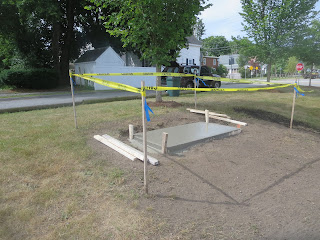
Concrete base, poured 6/27/25
This story is almost complete. A concrete base for the sculpture was poured on June 27th. Installation was completed two days ago. The entire project came in under budget, and here we are today!! 

Again, thank you for joining us today for this dedication event. The sculpture group (and the Town of Maynard) now have to decide if this was a one-and-done effort, or can Maynard become home to more public art. For if the goal is Making Maynard Interesting, we are making great progress.

click on photos to enlarge

The group, renamed "Maynard as a Canvas" has proposed a new sculpture idea - a giant sheep - to the Maynard Culture Council for 2026 funding.

Sunday, March 2, 2025

Maynard's largest trees (prove me wrong)

The "Buttonball" sycamore in
Sunderland, MA


This will be a work in progress, especially as more tree species are identified and competing trees are nominated for what is already on the list! 

Determining how large a tree is actually has a formal definition involving girth, i.e., circumference in inches at 4.5 feet off the ground, plus height in feet plus 0.25 times average spread measured in feet, 'average' coming from adding widest spread and smallest spread and dividing that by two. The end result is a point score referred to as "Tree Points." Massachusetts actually maintains a big tree registry, for which it is possible to nominate trees and a field inspector will visit the site to verify measurements. See https://www.mass.gov/guides/massachusetts-legacy-tree-program#-is-your-legacy-tree-a-champion-tree?- I suppose barring any expectation that a Maynard tree is the state's largest, I can purchase a clinometer and a measuring tape, and start stalking trees on other peoples property. However, for the moment, for the trees listed here, the listing is based on my unmeasured eyeballing: 

Golden Chain Tree
Paper Birch: back yard of 10 Maple Street

Eastern Redbud: side yard of 10 Maple Street

Golden Chain Tree: back yard of 10 Maple Street

Sugar Maple: back yard of 12 Maple Street

American Dogwood: front yard of 12 Maple Street

European Copper Beech: side yard of 80 Acton Street

American Sycamore: corner of Nason and Main streets

These are by no means the largest in the state. For example, the beech tree on Acton Street has a diameter of 6.7 feet and the state's largest is reported at 8.4 feet. The "Buttonball" sycamore, Sunderland, MA, has a diameter of 8.1 feet and height >110 feet. Its age is estimated at ~400 years.


Saturday, February 8, 2025

Boston's Record Snow Winters

 This is a repeat of a 2015 column that acknowledged 2014-15 being a record snow winter for Boston. Since then, most were in the normal range of 30-50 inches, but the 2022-23 winter was a near-record low of 11.6 inches. As of Feb 10th, Boston has had 22.5 inches for 2024-25.

History shows a very wide range between high- and low snow winters
There are winters wherein February sees the first crocuses of spring, but it is not this year. There are years wherein the first returning robins are already arriving, but it is not this year. There are years the snow blower goes untouched, the snowmobile trailered to Maine, but not this year. This year we struggle against the white, the ever recurring, ever piling higher snows of the winter of 2014-15. By all that you hold dear on this frozen earth, you must shovel, women and men of Massachusetts.   

This winter's snow is rapidly closing in on setting a new record for Boston, for Worcester, and for points in between. These cities, each with 125 years of weather data, average 44 and 64 inches, respectively. The snowiest winter on record for both cities was 1995-96, at 107.6 and 132.9 inches. As of February 23rd, Boston is at 99.8 inches and Worcester 107.7 inches. This winter already ranks second for Boston, with every expectation that it will finish as the snowiest winter in recorded history. Worcester is currently fifth snowiest.  

Snowfall measurement methods are described in great detail in a document from the National Weather Service. Briefly, if snow is falling continuously, depth in the measuring device is measured every six hours, the device emptied and set out again. Results are added up.   

One reason for this record-breaking season is that all snow is not created equal. Wet snow means that 6-8 inches converts to one inch of water, but the northeasters that have been repeatedly sweeping through our area have been cold enough to generate powdery snow that is averaging 17-18 inches per inch of water. Telling here is that the thirty days of storms that put so much snow on the ground will in time melt to only five inches of water - not much above average for this time of year.  

Parking meters near CVS
Other reasons are meteorological. Weather forecasting professionals toss about terms such as North Atlantic Oscillation, the "Ridiculously Resilient Ridge" and Polar Vortex.  The net result was that over a short period of time the storms were colder, larger, and every storm dumped on eastern Massachusetts, with little melting in between.       

Whatever happened to global warming? The short answer is that New England is getting wetter faster than it is getting warmer. For Boston, over a 120-year period the average temperature has gotten one degree (F) warmer, but 10 percent wetter. As a result, winter is two weeks shorter, but six of the top ten snowiest winters have occurred in the last 22 years. As storms track up the east coast the warmer (and thus wetter) air over the ocean blows inland over/atop cold air, resulting in snow, snow and more snow.

At some point in the future this will mean more winters of wet snow, sleet, ice storms and rain. Portland, Maine has already experienced the crossover: weather records dating back to 1870 show two degrees of warming, a 15 percent increase in total precipitation, but a decrease in annual snowfall from 75 to 65 inches. When it comes, the crossover will affect Boston before it impacts the inland cities and towns.

The first paragraph of this column was a riff on the "But it is not this day" pre-battle speech in The Lord of the Rings movie, The Return of the King. Other fictional pre-battle speeches to outnumbered, underdog troops include those from movies Braveheart and Independence Day, and the progenitor of them all, the St. Crispin's Day speech from Shakespeare's play, Henry V. That speech gave us five repeats of "...this day..." and also the line "We few, we happy few, we band of brothers..." See below. 

NOTES

The Lord of the Rings/The Return of the King (Lord Aragorn speaking)

Sons of Gondor, of Rohan, my brothers!
I see in your eyes the same fear that would take the heart of me.
A day may come when the courage of Men fails,
When we forsake our friends and break all bonds of fellowship,
But it is not this day.
An hour of wolves and shattered shields when the Age of Man comes crashing down,
But it is not this day!
This day we fight!
By all that you hold dear on this good earth,
I bid you stand, Men of the West!

Henry V (King Henry V speaking)

What's he that wishes so?
My cousin Westmoreland? No, my fair cousin:
If we are mark'd to die, we are enow [enough]
To do our country loss; and if to live,
The fewer men, the greater share of honour.
God's will! I pray thee, wish not one man more.
By Jove, I am not covetous for gold,
Nor care I who doth feed upon my cost;
It yearns me not if men my garments wear;
Such outward things dwell not in my desires:
But if it be a sin to covet honour,
I am the most offending soul alive.
No, faith, my coz, wish not a man from England:
God's peace! I would not lose so great an honour
As one man more, methinks, would share from me
For the best hope I have. O, do not wish one more!
Rather proclaim it, Westmoreland, through my host,
That he which hath no stomach to this fight,
Let him depart; his passport shall be made
And crowns for convoy put into his purse:
We would not die in that man's company
That fears his fellowship to die with us.
This day is called the feast of Crispian:
He that outlives this day, and comes safe home,
Will stand a tip-toe when the day is named,
And rouse him at the name of Crispian.
He that shall live this day, and see old age,
Will yearly on the vigil feast his neighbours,
And say 'To-morrow is Saint Crispian:'
Then will he strip his sleeve and show his scars.
And say 'These wounds I had on Crispin's day.'
Old men forget: yet all shall be forgot,
But he'll remember with advantages
What feats he did that day: then shall our names.
Familiar in his mouth as household words
Harry the king, Bedford and Exeter,
Warwick and Talbot, Salisbury and Gloucester,
Be in their flowing cups freshly remember'd.
This story shall the good man teach his son;
And Crispin Crispian shall ne'er go by,
From this day to the ending of the world,
But we in it shall be remember'd;
We few, we happy few, we band of brothers;
For he to-day that sheds his blood with me
Shall be my brother; be he ne'er so vile,
This day shall gentle his condition:
And gentlemen in England now a-bed
Shall think themselves accursed they were not here,
And hold their manhoods cheap whiles any speaks
That fought with us upon Saint Crispin's day.


Sunday, January 26, 2025

Yucca as Assabet River Rail Trail Plantings

Yucca and other flowering plants at Maple & Brooks
In eastern Massachusetts, if you’ve seen a low-to-the-ground plant with very long, very stiff, ‘sword-shaped’ leaves that come to a sharp point it is most likely a species of yucca known as Adam’s Needle. More than a dozen have been planted in Maynard adjacent to or near the Assabet River Rail Trail, courtesy of unsold plants from the Maynard Community Gardeners annual plant sale, donated to Trail of Flowers (www.trailofflowers.com). Look for a couple of nice specimens at the intersection of Maple and Brooks streets, fronting a stone wall. The wall itself is not a historic remnant, but rather a twenty-first century build.

Yucca is a genus of some 40-50 species of perennial shrubs and trees notable for their rosettes of evergreen, tough, sword-shaped leaves and large terminal panicles of white or whitish flowers. They are native to the Americas and the Caribbean in a wide range of habitats, from humid rainforest and wet subtropical ecosystems to the hot and dry deserts and savanna. A few species are winter hardy and popular as landscape plants.

Trail of Flowers signage, north of Summer Street
Adams’s Needle (Yucca filimentosa) is native to the southeast – Virginia to Florida – but is winter hardy to Zone 4, meaning it can prosper well up into Vermont, New Hampshire and Maine. Plants grow to about three feet tall and wide. Each plant has a central core from which the leaves radiate symmetrically and also near-vertical to flat, so the plant can be thought of as roughly hemisphere-shaped. Leaves are kept through winter. New cores emerge inches to a foot away from the original plant. As years pass, leaves closest to the ground turn brown and die, but are still firmly attached to a core. In time the cores rot, and entire dead plants can be removed by hand, leaving more room for the adjacent younger plants.

This species prefers full sun and well-drained soil, as shade will stunt growth and wet soil rot the roots. In time, it develops a large, fleshy, white taproot with deep lateral roots. Once planted and established, it is difficult to remove, as any remnant roots keep sending up new shoots.

In addition to the green-leafed native plant, Adam’s needle comes in colorful cultivars: Bright Edge, Color Guard, Golden Sword, Blue Sentry, Garland's Gold and Excalibur. For all, the leaves bear tiny thread-like filaments around their edges, which appear as if the plant is peeling. Images can be found via internet search. Nurseries carry cultivars or can special order. Beyond the first year, the plants are drought-resistant and do not need fertilizing. Plants can live up to 50 years.

Yucca clusters can put up 
multiple flowering stalks
Once well established, Adam’s Needle plants produce flower stalks decorated with bell-shaped flowers. The stalks can exceed eight feet in height and will display dozens of waxy, off-white-colored flowers. The flowers last for several weeks. The stalks die, and need to be cut. The flowers are considered edible, either raw, added to salads, or added to broth-type soups, akin to using unopened daylily flower buds in hot-and-sour soup or Thai Pho. (Do not eat Easter lily buds. All parts of Easter lilies are extremely toxic for domestic cats, causing acute kidney failure. Evidence for toxicity for dogs and humans is vague, but to be on the safe side, don't.) 

Not here, but in native areas in the southeast, Adam’s Needle flowers are pollinated by yucca moths. The moths transfer pollen from the stamens of one plant to the stigma of another, and at the same time lays an egg in the flower; the moth caterpillar then feeds on some of the developing fruit/seeds but can leave enough seeds to perpetuate the species. Each flower develops a fruit that is about two inches long, edible raw or cooked after the bitter seeds are removed. In the southeast, Native Americans split the leaves to make ropes, fishing nets and baskets. Peeled roots, pounded between rocks and mixed with water, make a lather than can be used to wash hair (A related species, native to the southwest, has the common name "soapweed".)

Other winter-hardy species that may be available for purchase from nurseries are Soapweed, Banana Yucca, Beaked Yucca, Spanish Dagger and Dwarf Yucca. These can flourish in Zone 5, which includes eastern Massachusetts.