Wednesday, October 27, 2021

William Knight - Amory's Original Partner

William Knight, courtesy of 
 Framingham Historical Soc.
William H. Knight (1793-1870) put more money into the partnership with Amory Maynard back in 1846, so why aren’t we living in Knightsville? One town wit quipped that when William Knight and Amory Maynard met, Knight had the money and Maynard had the experience, but by the time their partnership ended, Maynard had the money and Knight had had an experience. The truth was more complex.

In the late 18th century, Calvin Maynard constructed a grist (grain) mill on Fort Meadow Brook, in Marlborough. The mill was soon converted to a sawmill and its operation was eventually passed on to a relative – Isaac Maynard – whose death in 1820 left his 16-year-old son Amory in charge. Amory, in addition to operating the mill, expanded into the construction business. He employed as many as 50 men. One of Amory's clients was mill owner William H. Knight, for whom he helped expand the New England Carpet Mill in the Saxonville section of Framingham.

Knight had arrived on these shores from England in 1824, age 32. He was an experienced mechanic with skills in waterpower and textile machines. He started as a mill superintendent in Framingham, moved to Tariffville, Connecticut to partner in a carpet mill, but soon relocated back to Framingham where he married Elizabeth Stone and started his own mill in 1829. The location was Saxonville, on the Sudbury River, where John Stone, Elizabeth’s ancestor, had built the first mill on that site in 1650.

Knight's original successes were modest. He and Elizabeth lived in rooms in the upper story of the factory, overlooking the millpond. Accounts had it that Elizabeth would sometimes fish from their windows to catch fish for their dinner. But by 1845, Knight's operations had expanded to three mill buildings and 232 employees.

Sometime around 1846 the City of Boston purchased the land, dam and water rights to Fort Meadow Pond from Amory Maynard. The amount paid is disputed – various website-posted accounts say as little as $21,000 to as much as $60,000. Even at the low end of that range, Maynard, at age 42, was a wealthy man. At the same time, Boston also purchased Knight's mills and water rights to Lake Cochituate (Long Pond). Knight received $150,000; the largest sum that had ever been paid by the City of Boston for water rights up to that time. Boston also bought water rights to Boon Pond and added a small dam.

In 1846 the two men, builder and mill owner/operator, ages 46 and 54, agreed to partner in a new mill operation on the Assabet River. They started buying land and water rights, including Asa Smith's mill on Mill Street and riverfront land from Ben Smith as a site for the dam. In 1847, Maynard completed construction of a wood-framed, three-story tall, 50x100 foot building which they named Assabet Mills. The new yarn and carpet making operation prospered. By 1852 two more wood-framed buildings had been added. Maynard later bought land around Boon Pond and had a taller dam built in 1864, to form the larger body of water renamed Lake Boon. He repurchased Fort Meadow Reservoir from the city of Boston for $8,000 in 1858. These upstream assets help to guarantee a year-round water supply to power the woolen mill.  

Although he had bought acres and acres of land, Knight was never in residence in the crude hamlet on a rocky river that was Assabet Village in those early years. He and his wife had moved to Boston in 1848. It can be guessed that he managed the marketing and sales of the mill’s carpet and cloth output from a Boston office. By 1950 the Fitchburg Railroad had reached Assabet, so in-person visits were possible, and daily mail served. Telegraph service reached Assabet in 1852.

In 1950, Knight sold his share of the business to Maynard for $50,000, of which 80 percent was a mortgage. Knight retired in 1852, at age 60, just six years after co-founding Assabet Mills. It is possible he had lost interest in the day-to-day operations after the death of his wife in September of that year. He still had a financial interest in the mill, and owned land. The mill went into foreclosure in 1861, during a national recession. Maynard was bought out for cash and assumption of what remained on his mortgage to Knight, while at the same time another investor bought Knight’s remaining in-town land holdings at below-market value. The mill was reincorporated in 1862 with new partners, including the buyer of Knight’s land. Amory Maynard became 20 percent owner and “Agent” (Chief Operating Officer). Knight no longer connected.  

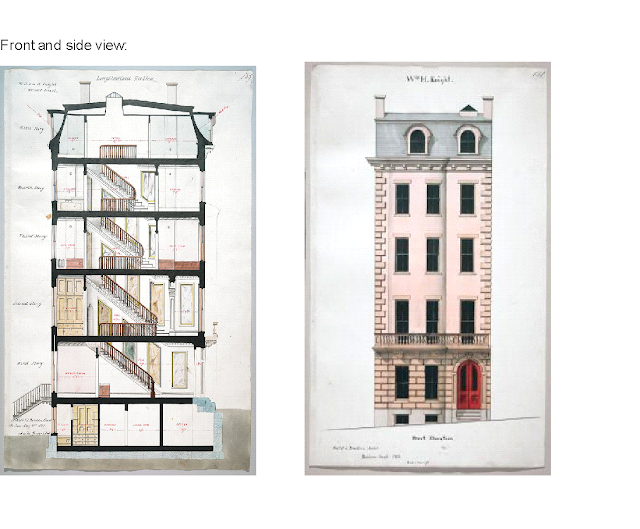
Interestingly, in 1858, six years a widower, Knight had an impressive, five-story, brick town house constructed at 7 Walnut Street, Beacon Hill, Boston. It was designed by famous Boston architect Nathaniel J.Bradlee. The building still exists. He lived there until he died in 1870, age 77 years. Knight and his wife had no children. History makes no mention of heirs. Elizabeth (Stone) Knight (1794-1852) was initially buried in Framingham, with a simple headstone. Before he died, Knight purchased a plot and paid for a more impressive monument at Mt. Auburn Cemetery, Elm Avenue, Lot #1979, Cambridge, and had Elizabeth reinterred there.
The aqueduct from Lake Cochituate to Boston was completed in 1848. On October 25th of that year a great celebration was held in Boston Common, with an estimated 100,000 people attending. The great day began with a 100-gun salute and an immense parade through the city, ending near Frog Pond, in the Common. Mayor Quincy gave a speech, at the end of which he asked if the people of Boston were ready for Cochituate water. "The crowd roared, the gates opened, and a fountain of water 80 feet high burst into the air." Cochituate was in service until 1951, supplemented and finally superseded by Wachusett (1908) and Quabbin (1946) reservoirs.

A version of this column was published in 2012 and incorporated into the 2014 book “Hidden History of Maynard.”


Saturday, October 9, 2021

The Maynard Family

On October 19, at 7:00 p.m., the Maynard Public Library will present a Zoomed talk titled: “Meet the Maynard Family.” It is produced by the Sesquicentennial Steering Committee as part of Maynard’s celebration of the 150th anniversary. Register at https://www.maynardpubliclibrary.org/may150 

Given the town was named after Amory Maynard in 1871, there is remarkably little presence of the man today. There is a street – Amory Ave – but no statue, no school, no park. There is a family crypt, and a clock tower built by his son. No descendants live in their namesake town.

Amory Maynard
In 1846, at the age of 42, Amory Maynard moved his wife and three sons from Marlborough to a house in the sparsely settled Assabet River valley, so that he and his partner, William H. Knight, could dam the Assabet River and build a woolen mill. They started with carpets—in time switching to blankets and wool cloth. Part of their good luck was already being in wool goods when the Civil War cut off northern cotton mills from access to southern cotton.

Looking in the ancestral direction, Amory was six generations away from John Maynard who had decided to leave England for the colonies. John transited the Atlantic, year and ship unknown, but by 1638 he was among the initial settlers of Sudbury. One branch of the family moved to Marlborough. The September 1850 census listed Amory and his wife Mary as heads of a two-unit household of 24 people that included his family, the Adams family, servants and mill workers. Lorenzo, the oldest son, was 21; Lucy Ann Davidson (a house servant) was 16. They married in October, she having just turned 17, and they had their first child thirteen months later. William married Mary Adams, the girl next door, in July 1853. Both marriages lasted more than 50 years and together produced twelve children. Harlan Maynard, the third son, died at age 18; one source specified typhoid fever.

William Maynard
William had a lesser role in the mill's business affairs than older brother Lorenzo. In the 1860s he lived in Boston for a while and worked for the Fitchburg Railroad. Tax records from 1871 find him back in Maynard, and show Amory, Lorenzo and William with incomes of $9,000, $4,000 and $800, respectively. The combined land ownership of the Mill, the A&L Maynard Company (a real estate and construction business) and Amory's personal holdings came to 270 acres. Ten years later, Amory owned a mansion on Beechmont Avenue (now Dartmouth Street), extensive land holdings and cash assets of $65,000; Lorenzo also owned a mansion, also on Beechmont and cash assets of $35,000. William at age 49, married and with seven children, was living in a house owned by his father.

Amory Maynard stepped down as mill Agent in 1885, shortly after having suffered a stroke. Lorenzo was promoted from Superintendent to Agent. Lorenzo's son William H. Maynard became Superintendent. "Agent" was equivalent to today's title of Chief Operating Officer. Although Amory was the largest shareholder, the post-bankruptcy financial reorganization of the Assabet Manufacturing Company in 1862 had resulted in T. A. Goddard becoming President of the Company.

At about the time of Amory's retirement, his son William moved himself, wife and five youngest of his seven children first to Pasadena and then to Los Angeles—at the time a smallish city of 25,000 people. Historical accounts state the move was for William's health—nature of illness unstated. It is plausible he had tuberculosis, as moving to a hot, dry climate was that era's treatment of choice. But it is also a bit interesting that he moved the year his brother took over the Mill. Regardless, three years later, William was well enough to relocate east, but chose Worcester over Maynard.

Amory Maynard's death in1891 left Lorenzo and William wealthy men. Lorenzo continued as Agent of the mill and Maynard resident. He personally paid for construction of the clock tower in 1892. William continued to live in Worcester until his death in 1906. At about the same time as the clock tower construction Lorenzo also paid for the chapel addition and installation of over a dozen stained glass windows in the Union Congregational Church, a place of worship which his father had been instrumental in getting started in 1852. Six of the windows were dedicated to Lorenzo's parents and to his four deceased daughters. For complex reasons, including an end of federal protective tariffs in the 1890s, the Mill failed in late 1898. It was purchased in 1899 by the American Woolen Company.

Only known photo of
Lorenzo Maynard
Lorenzo moved to Winchester, where he died in March 1904, a millionaire at a time when an average worker's wages were $500 per year. His son William H. Maynard was his sole surviving heir. An October 1904 newspaper article noted that Lorenzo and five other deceased family members were relocated from burial in Maynard to a new mausoleum in the Mount Auburn Cemetery, Cambridge—a place where all the "best" people were being buried. Correspondence on file at Mount Auburn confirms that Lorenzo bought the plot, #6111, on Crystal Avenue, in April 1903 and immediately ordered the construction of an impressive structure made of granite, twenty-four feet tall, with five stained glass windows. Contributing causes for the post-mortem move were bad feelings left over from being displaced at the Mill, plus the 1902 effort to change the town's name to Assabet.

William’s oldest daughter, Mary Susan, had remained in Maynard when the family decamped to California. Her granddaughter, Mary Sanderson (1874-1947), was the last descendant to live in Maynard. Between deaths and daughters, the family name vanished. There are differently surnamed living descendants via Lessie Louise and Harlan James, but none here.

Inside the crypt, looking
up at the skylight
The family crypt, located on the north side of Glenwood Cemetery, is an imposing earth-covered mound with a granite facade facing the road. The mound is 90 feet across and about 12 feet tall. The stonework facade is 30 feet across. The ceiling of the crypt has a glass skylight surmounted by an exterior cone of iron grillwork. "MAYNARD" graces a granite lintel above the entrance. The six-foot tall double doors are intricately carved Italian marble. One door had been cracked across and repaired.

Inside, there are eight vaults, three each on the left and right sides and two across the back. Each vault was designed to hold three caskets. Above the three on the left is "W. MAYNARD." Above the two at the back is "A. MAYNARD." Above the three on the right is "L. MAYNARD." Some of the vault doors have names and dates incised. In the center of the room is a large marble-topped table. The crypt was constructed in 1880, while Mary (1805-1886) and Amory (1804-1890) were still alive. They are both interred there, along with their third son, Harlan, who had died in 1861 and was first buried in the cemetery, later relocated to the crypt.

As mentioned, Lorenzo and his family are interred at Mount Auburn Cemetery. William and his wife are buried in Hope Cemetery, Worcester. They had moved to Worcester in 1888. Of their seven children, Mary S. Peters is the only Amory grandchild buried in Maynard.

Maynard family descendants visit family crypt (2018) 
Click on photos to enlarge
Because no descendants live in Maynard, there has been a bit of misconception that there were none. Not true. William had seven children. William’s daughter Lessie Louise Maynard married Paul Beagary Morgan of the wealthy and well-known Morgan family of Worcester. Lessie and Paul had five children, who begat children of their own. Another line descends from William's son, Harlan, to his son John, to three daughters. Hence, none of the descendants have Maynard as their last name. In 2018, one great-great-granddaughter of Amory and Mary, and six great-great-great grandchildren visited Maynard to see the family crypt and peruse parts of the town familiar to their ancestors.


Tuesday, October 5, 2021

Tools Named After Inventors

Mattock/axe combo, COLLINS AXE brand
I had reason recently to use my trusty Collins Axe axe/mattock to break ground for daylily plantings along the Assabet River Rail Trail. This is a handsome tool, what with a 36-inch-long fiberglass handle in black and yellow, capped by a five-pound, high carbon steel head. Perfect for breaking up tough turf and chopping through small roots. There is also a five-pound version with a pick/mattock head. I was disappointed to learn that “Collins Axe” was not the name of this specific tool, but rather, a brand name for many handtools.

For those not tool-savvy, an axe has a sharp blade parallel to the handle. Axes can be single- or double-headed. An adze is single-headed, with a sharp blade perpendicular to the handle. Adzes are carpenters’ tools, for shaping wood. A mattock has dull blades, suitable for breaking through turf and roots. A double-headed mattock can have blades parallel and perpendicular (axe and adze) or be a pick and mattock combination. For both of these, the mattock is the larger blade.  A “Pulaski” is a forest firefighter’s version of a double-headed tool, with a sharp axe blade and a smaller adze blade.  

Samuel Watkinson Collins founded the Collins Company with his brother and their cousin in 1826. They started with making axes – a tool that every pioneer, logger, and builder needed at that time. By 1859, Collins employed 350 people and produced 2,000 tools daily, having added picks, sledge-hammers, sugarcane cutting knives, machetes and more. At one time, the company produced 80 percent of the world’s machetes. Collins died in 1871. The company of his name continued at the same site until 1966, sold, moved, moved again. “Collins Axe” is now a brand for Truper, a Mexico-headquartered international manufacturer of tools, including shovels and wheelbarrows.

The Allen wrench, fitting snugly into the indentation on a screw or bolt, was the trademarked invention of William G. Allen in 1910. He also had a U.S, patent awarded to a method of manufacturing the screwhead. Much like Collins, this was originally a Connecticut company named after the founder. He moved on, the company was sold/acquired several times, and is now a brand name, with manufacture in Asia. Headless screws were promoted as a safety feature in factories because a when the tops of the screws were flush with moving machine parts those were much less likely to catch the clothing of workers and pull them into injurious contact.

As to why the Allen screwhead has a six-sided indentation, Peter Robertson of Ontario, Canada, had earlier patented and put into production a means of making a screw head with a square indentation circa 1909, after having badly cut his hand on a “flat-blade” screwdriver. Henry Ford, founder of the Ford Motor Company found this design so time-saving that he proposed paying for an exclusive license. Robertson refused. Allen went six-sided to avoid infringing the Robertson patents.    

Next, we turn our attention to the Phillips screwdriver. John P. Thompson invented and patented a cross-headed screw and screwdriver combination, the major improvement over the flat-blade type that it would not slip out to one side or the other of the screwhead. After failing to interest manufacturers, Thompson sold his self-centering design to Henry Frank Phillips. Phillips improved the manufacturing process of the screwhead, which was technically much more difficult than machining the screwdriver. One of the first customers for a non-exclusive license was General Motors. By 1940, 85 percent of U.S. screw manufacturers had a license for the design. Robertson’s desire to have a patent-protected monopoly had cost him the major market share of screws and drivers to the Allen and Phillips designs.

Jules Leotard (1838-70) was
a French acrobat who developed
tight-fitting clothes
There is worldwide agreement that screws and bolts tighten when turned to the right, i.e., clockwise, and loosen when turned to the left. There are rare instances where left-threading is needed. For bicycle pedals, if there were right-threading on the left pedal, the friction of the pedal while it revolves around the shaft would gradually loosen the pedal. For this reason, right pedals are right-threaded to tighten and left pedals are left-threaded.

Wikipedia has a long list of objects named after their inventors. A selection: Bloomers, Bowie knife, Bunsen burner, Derrick, Diesel engine, Ferris wheel, Franklin stove, Gattling gun, Graham crackers, Jacuzzi, Leotard, Macadam (asphalt), Mason Jar, Murphy bed, Otis elevator, Pilates, Pulaski axe/adze, Tupperware, Yale lock, Zamboni and Zeppelin.

Inventions are also named after places: Adirondack chair, Bikini bathing suit, Damascus steel swords, Duffel bag, Denver Boot, Jersey barrier, Panama hat, Rugby football, and so on.


Thursday, September 16, 2021

More about Maynard's School System

On September 30, at 7:00 p.m., the Maynard Public Library will present a Zoomed talk titled: “Maynard’s Schools Through the Centuries.” This is the eighth in a monthly series of history lectures produced by the Sesquicentennial Steering Committee as part of Maynard’s celebration of the 150th anniversary of its creation. Register at https://www.maynardpubliclibrary.org/may150. The October talk will be “The Maynard Family.” A new history book “MAYNARD MASSACHUSETTS: A Brief History”, is for sale for $21.99 at 6 Bridges Gallery, 77 Main Street, WED-SAT, 12-5. 

Last week’s column about school buildings down the centuries had little to say about the people in those schools. As resources, the Maynard Public Library has copies of the town’s annual reports back to 1871, each with a subsection on the school system. Also useful, the Maynard Historical Society has a sizeable collection of the high school yearbooks, all of which have been scanned and can be read in their entirety on-line.

At the time of the incorporation of Maynard in 1871, town population 1800, the new town was served by ten teachers working in four small school buildings. Salaries were in the range of $9-15/week. The high school was a two-room wooden building on Nason Street, now site of the library. High school enrollment was 35 students.

Twenty-one years later. the high school graduating class of 1892 chose orange and black as the school colors. (The Town of Maynard decided on official town colors of blue and white in 1917. Who knew?)  Mr. E. Elmer Galger, principal and acting superintendent, was paid a salary of $1,061. At that time, state law required that a child shall go to school twenty weeks in each year until 14 years old (changed to 16 years old in 1913). Not until 1898 did state law prohibit children under 14 year of age doing factory work. Farm work had no age limit. Few students completed 12 years of schooling. Often, their parents encouraged them to leave school and get a job in order to supplement the family income. Circa 1910-20, the graduating class numbered in the teens.

Graduating class of 1917, Maynard High School, 
Maynard, MA (courtesy historical society)
The 1918-19 school year saw schools suspended for five weeks as part of the national effort to contain the influenza pandemic. In Maynard, deaths attributed to influenza/pneumonia amounted to a bit under one percent of the population. Nationwide, deaths were estimated at 0.6 to 0.8 percent of the population of 105 million.   

School annual reports provide information on peaks and valleys in school enrollment, and also on the quality of education. There had been a huge spike in births 1900-1920, reflecting a tripling in the town’s population after the American Woolen Company bought and expanded the woolen mill, and also built and rented houses in the “Presidential District.” There was a peak in school enrollment 1923-30, reaching 1,750 students. This was less than might have been expected considering births, but childhood mortality was high, and as noted, many students left school at the earliest possible age. Births were low 1930-45, not a surprise given the Great Depression and World War II. Enrollment had dropped to under 1,000 around 1943-47. Post-war, new housing on the north side of town in combination with the “Baby Boom” reaching a peak 1960-75, led to school enrollment cresting at 2,100 around 1968-75. Once the “Boom” children were past school years, enrollment dropped to around 1250 for 1986-93, and then recovered to the mid-teens, where it remains.

The 1909 annual report mentioned that among 14 neighboring towns, Maynard had by far the lowest school budget at $22,000. Come 1937, the budget was $98,000, and of a state survey of 83 towns, Maynard was 73rd in expenditure per student. Year after year after year, the school superintendents’ annual reports mentioned that Maynard lost teachers to other towns that paid more   

Alumni Field became the school's sports site long before the high school moved to the south side of town. In 1928, while Maynard High School was still at the Summer Street location, the town transferred the land that had been the Town Poor Farm meadow to the school department. The football team started using the new playing field for the 1928 season. Within a handful of years Alumni Field gained a cinder track around the playing field, bleachers, a field house and tennis courts.

Click on photos to enlarge
Until the mid-1960s, elementary and middle schools had morning and afternoon sessions, with children going home for lunch. Presumably their mother or another adult family member would be home days. Not until 1971 did schools start providing lunch. Also, until mid-1960s, high school hours were 8-1, with no afternoon session. Driver education started in 1949. Special Education, per new state law, started in 1955, with students initially being bused to Concord. WAVM went on the air in 1973, at 60 hours of radio broadcasting per week, with 75 licensed student broadcasters.   

Massachusetts voters endorsed the tax-increase-limiting Proposition 2-1/2 in 1980. A large impact to school operations was foreseen. In Maynard, this, in combination with a fast-declining enrollment, led to a massive disruption. In 1981, 51 positions eliminated (25 professionals and 26 non-teaching positions). Teacher:student ratios were increased. Coolidge School closed after 75 years of service.

AND THERE IS SO MUCH MORE INFORMATION, which may have to wait for a third article, after the September 30 talk.

Wednesday, September 15, 2021

Maynard's Schools Through the Centuries

A chair from the "Brick
School", in the Maynard
Historical Society collection. 
Surprisingly, the two oldest school buildings – predating the creation of Maynard – are still with us. In the spelling of the era, the goals were to "teach children to rede and wright and cast accounts". Sudbury appears to have voted in 1779 to build a one-room schoolhouse for the northwest district, in 1871 moving that building farther north to what is now the intersection of Routes 27 and 117, where it served as Maynard’s “Turnpike School” until 1881. No longer a school, moved again in 1884 to corner of Concord and Acton streets – a distance of one mile – where it abides as a private home. On the Stow side of the Assabet River, District No. 5 had a school constructed in 1766: the “Brick School.” This was on Summer Street, hence became a Maynard school in 1871. It was closed the following year. It remains in place as part of the home at 101 Summer Street. Two other schools also pre-dated Maynard. One two-room building at the site of present-day Town Hall served until the town decided to replace it with its first multi-room brick school at the same site. The other, the first school on Nason Street, was lower grades, then first high school, then lower grades again.

At the time of the incorporation of Maynard in 1871, the new town was served by ten teachers working in four small school buildings. Salaries were in the range of $9-15/week. The high school was a two-room wooden building on Nason Street. Enrollment was 35 students. Six years later the high school classes relocated to a new two-room school on Acton Street, across from the east end of Main Street, leaving the Nason building to revert to elementary school.

Nason Street School (1892-2016)
The year 1892 saw a consolidation of Main, Nason, Acton and Sudbury schools into a two-story, twelve-room, wooden building at the Nason Street site, on the same stone foundation that is now the first floor of the Maynard Public Library. For a time, this was Maynard’s only school building, serving all grades.

The mill went bankrupt in 1898, then purchased and reopened in 1899 by the American Woolen Company. Expansion added the very large Building No. 5 on the south side of the millpond in 1902. The workforce grew, as did the town’s population: from 3,142 in 1900 to 6,390 in 1910. The population explosion of school-age children, especially in the Presidential Village housing development of 1901-03, led to the construction of new, brick-constructed schools at the Main Street site (1903) and on Bancroft Street (1906). The first was renamed Woodrow Wilson School in 1932. The second had a second floor of four more classrooms added in 1910 and was renamed Calvin Coolidge School in 1932.        

Remains of the Nason Street School fire
September 20, 1916, a nighttime fire brought an end to the Nason Street School. This was attributed to arson, as there had been a less damaging fire at the school just a week earlier. All that was left standing were the two brick chimneys. For a disaster, the timing was good. Three years earlier the town had voted to build a new high school, the site later chosen on Summer Street. The two-story brick building – currently the east wing of ArtSpace, was built at a cost of $61,500 and occupied October 2, 1916. This was the high school through 1964. A new, brick, elementary school was constructed at Nason Street, atop the foundation of the fire site. It opened fall of 1918, named Roosevelt School 1919. It served as a school through 1988, stood empty almost 20 years, resurrected as the Maynard Public Library, July 2006.

Meanwhile, back on Summer Street, the Town of Maynard, in its wisdom, decide to redirect a stream that flowed next to the high school into an underground storm sewer and build a junior high school, auditorium and gymnasium atop it (probably contributes to why ArtSpace is flood prone). The junior high opened January 1926, named Emerson Junior High School in 1932. After the high school moved to its new south-side campus in 1964, half the building became Fowler Elementary School and the whole complex became known as Emerson-Fowler School. In time, the junior high school took over the entire building as Fowler Middle School, remaining as such until the end of 2000.

Coolidge School originally built as one story
Back on Main Street, Wilson School was closed in 1942 because the school population had decreased dramatically, reopened in 1948 when the post-war baby boom started to arrive, and then was destroyed when a pre-dawn fire on December 17, 1952 left only the scorched brick exterior standing. This left Coolidge and Roosevelt as elementary schools.

The next phase for the Maynard school system was to create three schools adjacent to each other, on the south side of Route 117, each to have adequate parking and adjacent fields for physical education classes. Green Meadow School was first. Land was taken from Crowe Park. The school opened for the 1956-57 school year. Coolidge was kept on until 1981. A major addition to Green Meadow was approved in 1986, completed for the beginning of the 1988-89 year, which led to the closing of Roosevelt in 1988. “Maynard High School” was completed in 1964 at a cost of $1,700,000. Fowler Middle School (leave the old building, keep the name) opened in 2000. And then, in 2013, the fifth Maynard High School was replaced by the sixth Maynard High School, at a cost of $42,500,000. Note that over the years, two schools were completely destroyed by fire (Nason 1916, Wilson 1952) and three were significantly damaged (Nason 1879, Emerson-Fowler 1978, Maynard High School 1992).

Separate from the public school system: Mrs. Smith's School for Girls (1848-1857) was run by Mrs. Susan Smith at the Levi Smith place on Great Road. In 1965, Saint Bridget’s Parish opened Saint Bridget’s Parochial School in a brick building on Percival Street, on a filled-in section of the mill pond. The school was staffed by Sisters of Notre Dame, who had a modest convent near-by. The building is now home to The Imago School, a private school offering a Christian faith-based education for grades pre-kindergarten through eighth grade.


Yes, correct spelling "current"