Monday, December 27, 2021

Riboflavin, aka Vitamin B2

About the most exciting thing one can say about riboflavin is that if your take too much of it, your urine will take on a bright yellow/orange tint. Other than that, riboflavin is present in a lot of foods, more so in animal-sourced than plant-sourced, and that in the United States, deficiency is rare. Circa 1941, analysis of wheat flour confirmed that the process of making white flour destroyed approximately 85 percent of riboflavin so in the United States a fortification program was begun that added riboflavin – and other B vitamins – to white flour. As of 2021, 56 countries require food fortification of wheat flour or corn flour. An additional 16 countries have a voluntary fortification program. For example, the government of India recommends 4.0 mg/kg for "maida" (white flour) and for "atta" (whole wheat) flour.

As to what riboflavin does, it is a precursor to the creation of two coenzymes. Enzymes are proteins – strings of amino acids coded for by DNA and manufactured by RNA. In humans, there are some 70-80 enzymes that need the riboflavin coenzymes to function. Riboflavin is recycled in these processes, so the dietary amount needed to replace what is lost to daily urine output is remarkably small – on the order of 1.5 milligrams per day. One chicken egg provides about 0.2 mg, a glass of milk about 0.4 mg. There are no known adverse effects from consuming large quantities because absorption has an upper limit, and what is absorbed in excess of needs is quickly excreted in urine.

No known health benefits can be attributed to consuming amounts in excess of what is needed to prevent deficiency. In many countries, a chemical compound is either naturally occurring in food or a drug, with strict regulations concerning the latter. However, in the United States, passage of the Dietary Supplement Health and Education Act of 1994 (DSHEA) allowed for the existence of a middle category, dietary supplements, that could be manufactured and marketed as long as there is clear evidence that these products are safe and some scientific evidence in support of a purported health benefit.

Basically, in the U.S., this means that a company cannot sell a drug until the Food and Drug Administration (FDA) approves, but can sell a dietary supplement until the FDA or Federal Trade Commission says to stop.

The FDA restricts label health claims to specific wording referred to as a Structure:Function claim. S:F wording is limited to phrasing such as “Supports…” or “Promotes…” or “Helps…” One example from a riboflavin product label reads “Promotes Healthier Blood, Nervous System and Helps Boost Energy and Metabolism.” Is this manner, riboflavin is sold in doses as high at 400 mg despite the fact that deficiency is avoided by consuming 1.5 mg/day. Dietary supplement labels are also required to include a black-line outlined statement concerning the S:F claims: “These statements have not been evaluated by the Food and Drug Administration. This product is not intended to diagnose, treat, cure or prevent any disease.” Despite these restrictions, the supplement business in the United States exceeds $35 billion per year. The products range from the mundane (multi-vitamin/mineral complex) to the exotic (powdered deer antler velvet).

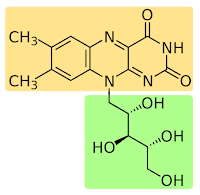
Riboflavin chemical structure, 
with the ribose portion in green
and the flacvin in yellow.
The name ‘riboflavin’ comes from being a ribose sugar attached to the part of the molecule which imparts the yellow color, “flavus” being Latin for yellow. The earliest reported identification, predating any concept of vitamins as essential nutrients, was in 1897. Alexander Wynter Blyth isolated a water-soluble component of cows' milk whey that fluoresced yellow-green when exposed to light.

In 1935, researchers reported that a yellow-fluorescing compound extracted from yeast restored normal growth when fed to rats. The compound was briefly referred to as "Vitamin G" before a consensus was reached for “riboflavin” and also “Vitamin B2.”  Richard Kuhn was awarded the Nobel Prize in Chemistry in 1938 for his work on riblflavin. A year later it was confirmed that riboflavin is essential for human health through a clinical trial in which women fed a diet low in riboflavin developed stomatitis and other signs of deficiency, all of which were reversed when treated with synthetic riboflavin. As confirmation, the symptoms returned when the supplements were stopped.

Mark’s day job, until he retired, was providing expert scientist advice to dietary supplement, sports nutrition and medical nutrition companies wanting to make health claims.


Wednesday, December 8, 2021

Maynard’s Many Food Co-operatives

Assabet CO-OP has
reached its funding goal
Maynard’s various histories/futures name nine co-operative associations or societies. The oldest was Riverside, the newest Assabet Co-op Market. The longest duration and largest was the United Co-operative Society. A Department of Labor report for 1947 mentioned that United was one of the top ten co-ops in the country for membership and annual sales. More than half the households in Maynard were members.

The backstory of co-operatives began in 1844 when a group of 28 weavers in Rochdale, England, organized the Rochdale Society of Equitable Pioneers, “…and opened their first store, with a small stock of flour, oatmeal, butter and sugar.” They soon added tea, tobacco and candles. Their guidelines formed the basis for the principles on which co-operatives around the world continue to operate. The Rochdale Pioneers became highly successful, with 1,400 members by 1855 and 5,560 members by 1870, able to shop at many stores.

There had been earlier attempts to establish co-operatives that were basically buyer’s clubs, which by pooling their purchases were able to buy at wholesale prices and sell to members at below retail prices. The Rochdale Pioneers innovated by adding profit-sharing to members based on a percentage of the cost of the goods the members purchased, i.e., a patronage dividend. The seven Rochdale Principles: Open membership, Democratic control, Distribution of surplus money, Limited interest on capital, Political and religious neutrality, No buying on credit, and Promotion via education.

Here in Maynard, Riverside was started in 1875 by English and Scottish immigrants. Many of them may have been familiar with the co-operative movement in Great Britain. Riverside began as a chapter in an American movement, the “Order of the Sovereigns of Industry.” This was an urban workers organization modelled on the Grange – a farmers’ organization formally known as the “Order of Patrons of Husbandry.” ‘Sovereigns’ was in effect a buyers’ club. Nationally, the Sovereigns organization faltered under financial mismanagement, but in 1878 the local chapter reformed itself as the Riverside Co-Operative Association, incorporating Rochdale principles.

Shares were $5 each (equivalent to about $125 in today’s dollars), members limited to 60 shares. The total capital investment was $1,500. Per the by-laws, regardless of how many shares owned, each shareholder had one vote. The operation started in the basement of the Darling Block building, moved to the Riverside Block (later Gruber Bros Furniture), and then in 1882 built its own building at the southwest corner of Summer and Nason. The building was a four-story wooden edifice, with the store entrance on Nason Street. The other floors were rented out.

By 1909, Riverside had more than 600 member families. In addition to quality of goods and competitive prices, members were paid a yearly cash refund ranging from 2 to 10 percent based on how good a year the co-op was having. Additionally, shares earned five percent interest. A decline started with the recession of 1920, compounded by cost of repair after a fire, same year. In 1929 the store business was sold to the store manager while the co-op continued to own the building. A large fire in January 1936 led to dissolution of the Association and sale of the site to Knights of Columbus, which had been a long-time tenant. Proceeds were divided amongst the remaining shareholders.

Riverside CO-OP 1920. Courtesy Maynard Historical Society
Contributing factors to the end of Riverside were that the children of the founders were moving up the socio-economic ladder at same time as immigration from England and Scotland was declining. A front-page newspaper article from 1913 had noted that prior to 1900 the town was mostly English origin, but expansion of the mill under new ownership had doubled the town’s population by bringing in large numbers of immigrants from Finland, Poland, Lithuania and Italy.

Of the smaller and shorter-lived efforts, Suomalainen Osuuskauppa was started 1899 by Finnish immigrants. Capitalized at only $800, it lasted a year before dissolving and selling its store to a private owner. The Maynard Co-operative Milk Association was formed in 1914. Three years later it become the diary operations of Kaleva Co-operative Association. Finnish members of the milk co-op who had not wanted to affiliate with the socialist/communist/atheist Kaleva had previously split off and formed the First National Association in late 1915. It owned and operated out of a building on the west corner of Main and River Streets until its demise in 1941. The International Co-operative Association was started in 1911 by immigrants from Poland, and lasted 20 years. It began in a building near the Methodist Church, later moved to space in the Masonic Building (100 Main Street). Membership numbered 200 to 400 over the years. First National and International failed in part because of extending credit to members during the Great Depression. The Historical Society has a share certificate for the proposed Russian Co-operative Association, dated 1917. The group did not reach its capitalization goal, instead operating briefly as a store co-owned by six Russian men.

As for the largest and longest lasting - “Kaleva” refers to an ancient, mythological, Finnish ruler known from a 19th century work of epic poetry and story-telling compiled by folklorist researcher Elias Lonnrot. The work, “The Kalevala,” is regarded as the national epic of Finland, instrumental in fostering a sense of Finnish national identity that culminated in the Finnish declaration of independence from Russian rule in 1917. Locally, immigrants had formed the Finnish Workingmen’s Socialist Society in 1903, from whom the 187 founders of the co-operative were drawn.

According to a book, “The Finnish Imprint,” a delegation of Finnish immigrants had initially approached the Riverside Co-operative Association with the idea of becoming members. Because many of the recent immigrants did not speak English, they asked that the co-operative hire Finnish store clerks. This suggestion was rebuffed, with a reply that if they did not like the service they received, they should start their own store. They did. The business was initially capitalized at $1,600 from sale of 320 shares at $5 per share. The initial location was a rented storefront at 56 Main Street. By 1912 the co-operative had bought the entire two-story building, soon after added a bakery operation, a dairy with home delivery, and a restaurant on the second floor, serving meals to hundreds of workers living in neighboring boarding houses.

Maynard was not the only home to a Finnish-organized co-operative. Fitchburg has the Into Co-operative and Quincy the Turva Co-operative. In 1919, Maynard and these and others merged to create the United Co-operative Society of New England. This was short-lived due to financial and political disagreements, the end result being that Maynard’s Kaleva group reorganized as the United Co-operative Society of Maynard.

United CO-OP fuel oil tanks
United’s by-laws had added an eighth principle to the previously describe Rochdale seven – Continuous expansion. Over the initial 50 years membership grew from 184 to 2,960 members as coal and firewood (1924), fuel oil (1933) and ice (1934) delivery were added. In addition to the Main Street store, a branch store was opened on the northeast corner of Waltham and Powdermill Roads (1926), superseded by moving the branch store operations to a new building at the northwest corner of the same intersection (1936). This remained active until it was sold to Murphy and Snyder printers in 1957. Next door, now the Seven-Eleven/Dunkin store, was an automobile gas and service station (1934). A credit union was added in 1948.

A report by the U.S. Bureau of Labor at that time stated that the United Co-operative Society of Maynard was one of the ten largest in the country, calculated either by number of members or annual sales, and was also one of the ten oldest. More than half the households in Maynard belonged to United. At its peak, the co-operative had more than 50 full-time employees, with medical benefits and life insurance – unusual for that era. 

United survived the competition from an A&P supermarket operating on Nason Street (in the building now housing The Outdoor Store), but the presence of Victory Supermarket on Powder Mill Road, combined with the freedom to shop elsewhere provided by increasing car ownership, put pressure on the co-operative. In June 1973 that was a near-unanimous vote to dissolve. United's By-laws had an interesting clause: On the occasion of dissolution, the assets would be used to pay the purchase value of the outstanding shares. Any surplus would go to the Co-operative League of the United States rather than to members.

And now, there is an effort underway to launch Assabet Co-op Market: “Our mission is to support the regional food system; strengthen the local economy; promote the well-being of our members, our community, and the environment; and be a center of community activity.”

The planned location of the Assabet CO-OP Market
The beginnings date to February 2012, when a small group of people met to discuss forming a co-op. The cost of membership was set at $200. To date, more than 1,700 people have joined. The co-op has achieved its capitalization goal of $2,000,000 in the form of interest-paying owner investment, which in combination with traditional bank financing will be sufficient to lease space at Victory Plaza, 86 Powder Mill Road, Maynard, and then convert it into a store with approximately 6,000-square-feet of retail space (with free parking).  Once launched, Assabet Co-op Market intends to make a point of sourcing food from local farms. And if all goes as planned, Maynard will once again be a co-operative town, 145 years after the start of the first.

UPDATE: More funding needed and opening delayed untii 2023. Problems are increase construction costs and delays in getting crucial equipment.

On December 14, at 7:00 p.m., the Maynard Public Library will present a Zoomed talk titled: “Maynard’s Many Co-operatives.” Register at https://www.maynardpubliclibrary.org/may150.
Wednesday, November 24, 2021

Maynard's Bridges Revisited

Florida Road bridge closed for replacement construction on December 13, 2021.

The Maynard Historical Society had in its collection a photograph of a wooden bridge across the Assabet River at Florida Road. The road was barely more than a cart path, and the caption with the photograph mentioned that wooden bridges at that site were repeatedly washed away by floods. A decision was made in 1914 to construct a rebar-reinforced concrete bridge, the first of its type in Maynard. The Town approved a budget of $6,500. The bridge was completed in 1915 for $6,011.  It is state bridge #M-10-006.

Even taking into account dollar inflation, that was a remarkable reasonable price. The current project to replace that bridge is budgeted at $3,362,437. Time-to-completion is estimated at two years, during which time the road will be closed to through traffic. As to why the bridge needs to be replaced, the Massachusetts Department of Transportation (MassDOT) has deemed it “Structurally Deficient” for years. Rebar-reinforced concrete was an extremely popular bridge construction material at the beginnings of the twentieth century. Concrete bridges have an expected safe lifespan of 50-70 years, depending on traffic burden and exposure to the elements (weather and road salt). This bridge is 106 years old. At the time the Florida Road bridge was constructed, there was no expectation for truck traffic, as immediately south, the road passed through a narrow, one-lane-wide underpass under the railroad. Hence, the bridge’s narrow lanes and poor sightlines were not considered unsafe, as bridge traffic speeds were expected to be slow and limited to horse-drawn vehicles and the automobiles of that era, but now make the bridge tagged as Functionally Obsolete in addition to Structurally Deficient.

Crumbling concrete an exposed rebar at base
of the 106-year-old Florida Road bridge
Florida Road is not the only bridge in the United States that is overdue for replacement. From a 2017 report, the U.S. has more then 600,000 bridges, of which 40 percent were more than 50 years old and 9.1 percent were Structurally Deficient (improved to 7.5 percent as of 2021). The estimated cost of remedying the nation’s backlog of bridge rehabilitation exceeds $100 billion.   

The MassDOT project to replace bridge #M-10-006 began in 2017 with a notice to proceed, traffic counts and confirmation of the state of deterioration. In places above and below the road surface, concrete had broken away, exposing steel rebar, which was rusting. Surveying was conducted in 2018. A preliminary design was presented to the town in February 2020. The existing bridge has 9-foot lanes, low curbs and 5.5-foot wide sidewalks; full width 30 feet. The new bridge will have a full width of 41 feet to accommodate 10-foot lanes, 4-foot paved shoulders to serve as bicycles lanes and 5.5-foot wide sidewalks. Much like the Waltham bridge replacement, this will be a concrete deck resting on steel beams. The additional width will all be on the downstream side. A recent walk through the site saw that about 40 trees on both sides marked for removal, some exceeding a foot in diameter, one-third of all the trees appearing to be dead.   

Sewer pipe under the existing Florida Road bridge (Click to enlarge)
One question of interest only to a few adventuresome people is the extent of vertical space under the bridge. With just the right river depth, it has been possible in the past to put kayaks and canoes into the river just downstream of the Ben Smith Dam, to pass through Maynard, crossing under six bridges. One of the proposal diagrams shows a 9-foot clearance between normal low water and the bottom of the steel beams. However, the diagram also shows water and sewer pipes suspended below the bridge, same as those exist at present. Successful passage would require water levels deep enough to float a boat, yet not so high as to make those pipes into head bangers.      

Foot-depth markers on wall
below John's Cleaners
Are any other of Maynard’s bridges deemed Structurally Deficient? Three reinforced concrete bridges date to 1922: Route 117/Great Road (also known as the Ben Smith bridge), Main Street and Walnut Street. These spans over the Assabet River were originally bridged in 1816, 1849 and 1865, respectively. The original bridge at Route 117 appears to have been a two-arch stone and mortar bridge that stood until the 1922 replacement. Main and Walnut were replaced by steel bridges in 1872 and then concrete fifty years later. Of the three bridges that are nearing their 100th anniversary, the Main Street bridge is officially Structurally Deficient, marking it as Maynard’s next bridge project. The other two still pass annual inspections. Maynard’s six other bridges range in age from 4 years (Rail Trail) to 84 years (Mill Street).    

Mark painted the foot-depth markers on the riverwall below John’s Cleaners.


Wednesday, November 17, 2021

Maynard's Transportation History - Part 2

The early years of the twentieth century were a watershed for local transportation. Electricity provided power for a trolley system (later replaced by a bus line). The advent of automobiles would in time end the golden age of bicycling (and passenger trains, and that bus line). Trucks would make obsolete the need for local freight trains.  

The trolley power station, now
the Indian Orthodox Church
There was an electric trolley system going by the name Concord, Maynard & Hudson Street Railway. It operated October 1901 to January 1923. In addition to the named towns, there was a spur north to South Acton and beyond, to West Acton. Trolleys ran every 30 minutes from 6 AM to 11 PM. From Maynard to the other towns cost a nickel. In addition to the standard passenger cars, CM&H operated custom-built luxury cars, for rented use. Think of these as the party limousines of the day. Each of the three cars, the “Concord, Maynard” and “Hudson” had carpeting, wicker chairs, electric lights and curtained windows. These private cars could be hired for trips, and were not limited to CM&H rails. There is a record of a day trip to Woonsocket, Rhode Island!

Worth a historical mention that in Boston and other cities, trolleys predated electric power. In 1890, the City of Boston had a horse-drawn trolley system, known then as the West End Street Railway Company. West End had 2,000 cars in service, and employed as many as 9,000 horses. Conversion to electric motors started in 1891. By 1897 the last horse was retired.

Charles H. Persons (center) being driven in his 1904
Ford Model A, on Main Street. Note trolley tracks. Photo
courtesy of Maynard Historical Society. Click to enlarge.
The first car owned in Maynard, a Stanley Steamer, was purchased by Dr. Frank U. Rich in 1899. The Harriman brothers, of Harriman Laundry also went in for steam-powered vehicles, but gas engines were a coming thing. Charles H. Persons purchased the first Ford in town in 1904. From a photo, this was likely a Model A: 8 horsepower, top speed 28 mph. Newspaper ads in 1914 offered Ford Model T cars for $500. By 1910, there were two car dealers in town, repair shops, gas stations, car rental businesses, attempts to control speeding, and the first reported accident (small boy hit, bruised but otherwise unharmed). By 1925 the town’s annual report numbered 879 motor vehicles in Maynard. The horse count had dropped from to 70. As of 2021, there are two used car dealerships, two rental businesses, four gas stations and a dozen or so repair and parts establishments. 

Steamboats operated on the Assabet River from 1906 to 1914, offering transportation from a dock at the rear of the trolley headquarters to Whitman’s crossing, at Lake Boon. The company started with one boat, named “Queen,” but in time added “Gertrude” and “Teddy.” Weekdays, boats departed every 30 minutes, 8 AM to 8 PM. At Whitman’s Crossing, a short walk to Lake Boon brought people to a dock where the “Princess” would take them to docks scattered around to lake, providing access to summer cottages, club houses, restaurants and drinking establishments.

The trolley barn, located on the west side of where Routes 62 and 117 merge, became the base for the Lovell Bus Lines (1923-1954). John Lovell started bus service from Maynard to the South Acton train station one month after the trolley stopped. In time, he added bus service to Concord and Hudson. Eventually the line was extended west to Clinton and Leominster, and east to Waltham and Revere Beach (summers only, round-trip $1.25). Lovell Bus Lines was sold to Middlesex & Boston Street Railway – which operated trolleys and buses – later merged with MBTA. Bus service for Maynard dwindled over time, ended in 1972.

As for airplanes, Sidney H. Mason created an airstrip in 1948, behind his house on Summer Street. Sid was 28 at the time, and an Army veteran. He and three friends bought a used Luscombe 1946 8A in 1947 for $1000. Sid bought out his partners soon after. The airstrip was carved out of what had been an extensive Mason family farm that dated back to at least 1875. In fact, back in the farm days, the family had two runways, and many of the pilots in Maynard and nearby towns kept their planes there. Sid was still flying as late as 1997, age 79. In the meantime, Sid's son - Jack Mason - had taken up his father's hobby while still in his teens, earned his pilot's license, and was flying a Vector Ultralight in and out of the backyard. This meant that “Sid’s Airport” continued to be an active, FAA-numbered airstrip (MA52). Sid Mason passed on to the big airport in the sky in 2005. His life-long love affair with the air is memorialized by his tombstone, as it portrays his Luscombe in flight, with the plane's registration number N72025 on the side. Jack sold the property in 2016.

The Monster.com blimp pictured flying over the
company's corporate headquarters, in Maynard.
The latest air experience for Maynard did not actually land here, but there was a valid connection. For many years, Maynard was the headquarters for Monster.com, a once vastly successful jobs search company. Circa 2002, Monster leased two blimps from Virgin Atlantic for promotional flyovers at sports events, etc. One of the blimps did a flyover of Maynard, captured in a photograph that includes the blimp, mill buildings and the clocktower. Not occurring anywhere near here, but in response to an “I dare you” from Richard Branson (the CEO of Virgin Atlantic), Jeff Taylor, CEO of Monster, water skied 3.3 miles being towed by his blimp, setting a world record. The previous record holder was Branson.

On November 23, at 7:00 p.m., the Maynard Public Library will present a Zoomed talk titled: “Transportation from Horses to Airplanes.” Register at https://www.maynardpubliclibrary.org/may150.

Wednesday, November 10, 2021

Maynard's Transportation History - Part 1

Kerosene street lamp, circa 1900. Courtesy of
Maynard Historical Society. Click to enlarge.
For people afoot, starting 1878, the Town of Maynard decided to providing lights for the thoroughfares of this new town. Amory Maynard was on the committee. The result was 25, six-foot tall, kerosene-fueled street lamps installed on downtown streets. By 1891, railing against darkness encompassed 74 lamps, lit sunset to midnight. (Anyone out past midnight was expected to have their own kerosene lamp.) A few businesses supplemented street lights with their own far more luminous gaslights.

In 1902, the Town of Maynard signed a contract with the American Woolen Company to provide power for 92 electric lights. Circa 1931, the Edison Electric Illuminating Company of Boston began supplying power, there having been contentious debate that the woolen company was charging more than market rates for its monopoly. Today, Maynard’s several thousand street lights are light emitting diodes, with the exception of early 20th century style ‘historic’ fixtures in downtown locations.

Horse count by year (light tint line)
Maynard’s Annual Town Reports included Assessors’ Reports which until 1933 included a horse tally. The maximum was reached in 1899 at 256 horses. Businesses moved goods about town by horse-drawn wagons. A wealthy family of this pre-car era might have a carriage house on the property and keep a horse on site, or board a horse at a livery stable in town. The site of the Fine Arts Theatre was once a livery stable. Larger operations such as Parmenter Farm on the north edge of town were caring for dozens of horses for various businesses. Maynard was also home to a number of urban barns. These were not remnants of working farms, but rather one-horse barns for people who carted goods about town or to and from the railroad.

Unlike cars, horses are not inert until needed. Horses consume 15-20 pounds of pasture grass or hay daily, and 10-20 gallons of water. What goes in comes out, so stalls needed to be mucked out daily, and new hay added for bedding. Grooming took time, as did ensuring horses got some exercise. Getting a horse into harness was much more time consuming than pushing the start button on a modern-day vehicle. The horse population gradually declined. By 1919 there were only 123 horses, then fewer than 20 when the count stopped in 1933. A few remained. Peter Grigas reminisced about how well into the 1950s he and his friends rode their family-owned horses from Maynard to Lake Boon on summer days, stopping at Erikson’s Ice Cream on the way back.

Steam engine trains, initially wood-fueled, then coal, reached Assabet Village in 1850. According to the centennial history book, Amory Maynard was a prime mover in getting the right-of-way secured, and as a reward, was given a lifetime pass. The first train ran July 1850. At that time the tracks extended only as far as north Marlborough – which became Hudson in 1866 – but were later extended to the center of Marlborough, a distance of 12.4 miles from South Acton, in 1855. Most of the traffic was freight, but it was possible to take a passenger train from the center of Assabet Village all the way to Boston, or detrain at South Acton to board a train heading west.

Railroad bridge over the Assabet River (1850-1979). There was
a smaller bridge underneath for carting coal. Location
is the site of the current Rail Trail bridge (2018)
Over the decades, there were a few minor accidents and two major ones. November 26, 1905, the local-stop passenger train from Boston to Marlborough left Boston at 7:16 p.m. The Montreal Express left the station 30 minutes later. There was fog. In Lincoln, near the bridge over the Sudbury River, the Express smashed into the rear of the local, killing 17 (9 from Maynard) and seriously injuring 25-30 others. Fault was attributed to the engineer of the Express, who had only recently been promoted from fireman. The flagman at the rear of the local, knowing it was running late, had dropped flares on the tracks so as to warn the following train, but the engineer had not sufficiently slowed the Express. The other accident was a derailment in Maynard, on Easter Sunday, 1911. Several people suffered minor injuries.

Train service declined in the twentieth century. Passenger service west of Maynard ceased in 1939; for Maynard the last passenger train was May 16, 1958. Freight service ceased about ten years later, bringing nearly 120 years of railroad to an end. In 1979, Mass Transit turned the right-of-way over to the towns, which in turn sold pieces to individuals and businesses. A vision of converting the abandoned tracks to a paved rail trail began in 1992. The five towns voted to approve the trail in 1998. The southwest end – Marlborough and of Hudson, 5.6 miles – was paved circa 2006. The north end – Acton and Maynard, 3.4 miles – was paved in 2018. The middle may never be completed, as some owners refuse to sell the land or permit passage.

Maynard bicycle club 1896
The “Golden Age” for bicycles was the 1890s – after invention of the air-filled tire and before cars and motorcycles. John Dunlop, a veterinary surgeon, experimented with putting air-pressurized rubber tubing inside a rubber tire. He patented the concept in 1888. By 1892, he was a millionaire, and the people of the United States were on their way to having ten million bicycles – for only 75 million people. Women took to wearing bloomers. There were demands for asphalt-paved roads. Bicycle racing and bicycle clubs were everywhere. Circa 1896, Maynard had a cycling club that favored the high-wheeler design – a large wheel directly powered by pedals, with a frame arching back to a small trailing wheel – over what came to be known as the ‘safety’ design, with its wheels the same size, a chain-drive to the rear wheel; and better brakes. A 1900 photo in the Maynard Historical Society collection is a group photo featuring the Priest brothers and their three-seater ‘safety’ bicycle.

Today, the fastest growing market segment is electronic/hybrid, i.e., combining battery power and pedaling. Usages are commuting, urban delivery (food and other), and recreational. Upsides include low operational cost. Downsides include safety and weather. Maynard and neighboring towns have implemented plans to promote safer sharing of roads. The towns also have miles of woodland trails suitable for mountain bike exploration.  

This is Transportation, Part 1. Trolleys to airplanes will be in Part 2. Some content in this column is in Maynard’s newest history book: MAYNARD MASSACHUSETTS – A Brief History (2020), which can be purchased at 6 Bridges Gallery, 77 Main Street, for $21.99.